



Agrilus planipennis
Agrilus planipennis
Popis druhu:
Bionómia – infekčný cyklus:
Symptóm:
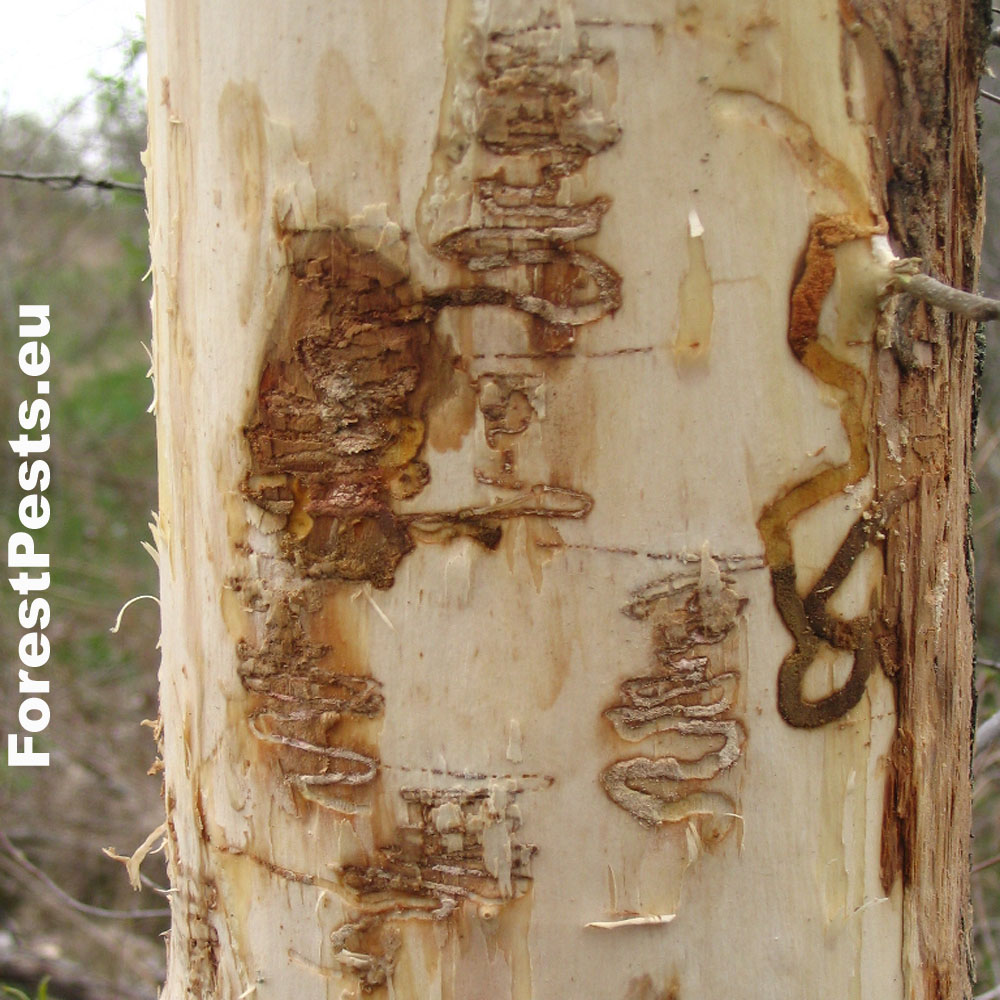
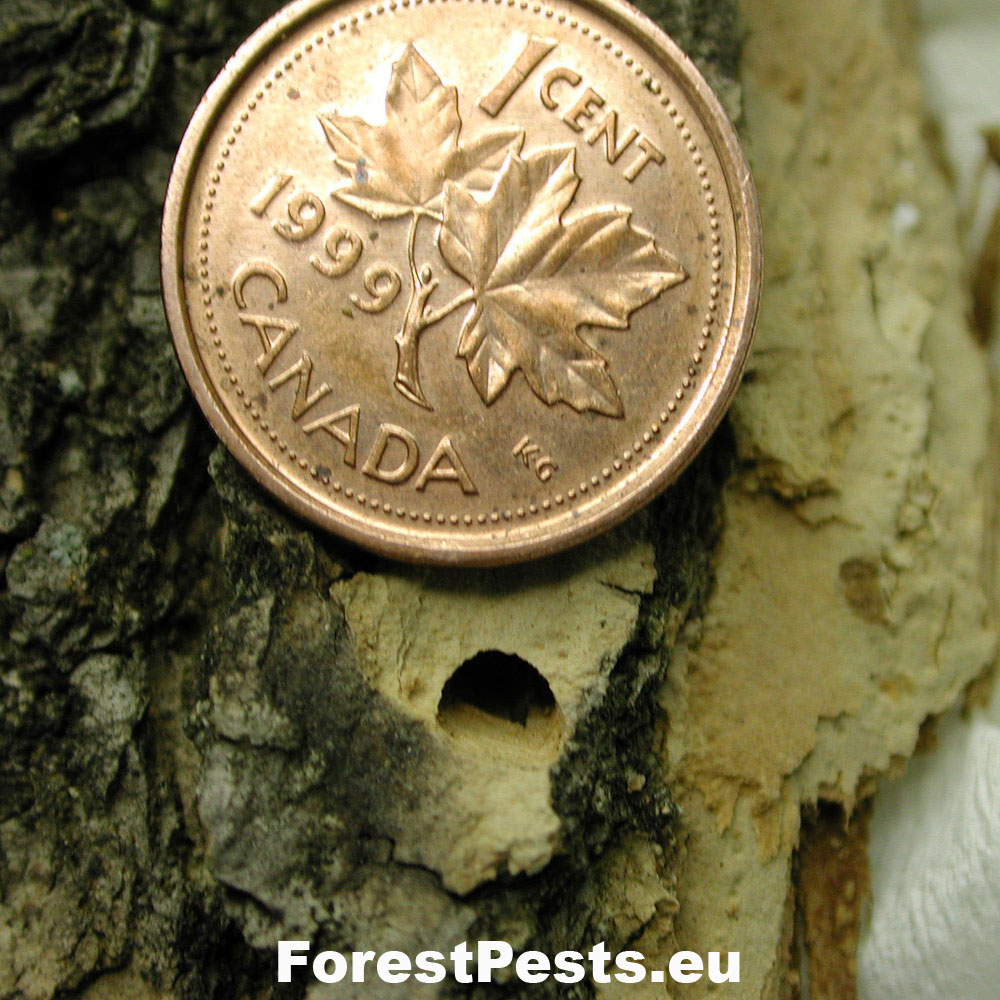
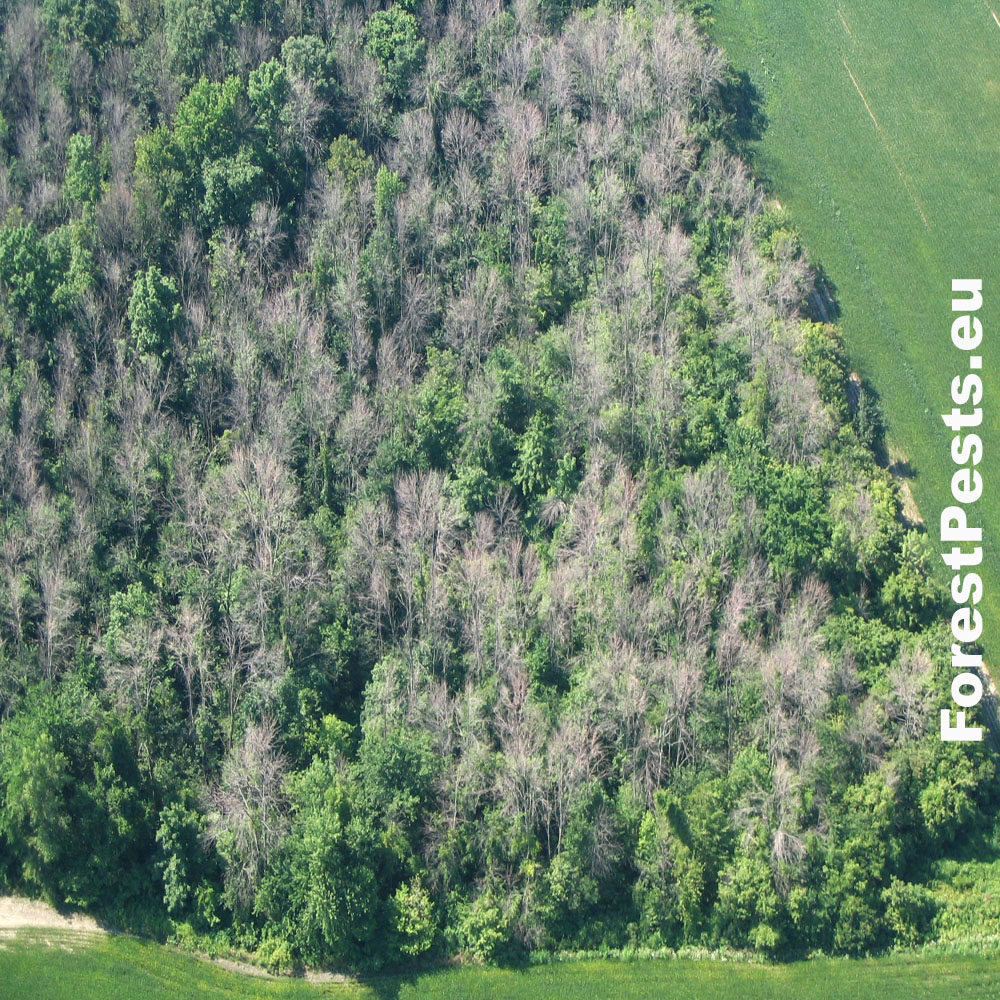
Novonapadnuté stromy je veľmi komplikované včas zaznamenať. Príznaky napadnutia sa ukazujú zväčša až v dobe kedy je strom významne poškodený. Asi najvýraznejšie je možné pozorovať zmenu sfarbenia listov a ich predčasný opad. Poškodenie stromu môže indikovať aj zvýšená kmeňová výmladnosť. Stromy tak môžu reagovať na významný stresový faktor. Podobne ako pri ostatnom podkôrnom hmyze aj v tomto prípade je dobré sledovať aktivitu ďatľotvarých vtákov prípadne aktivitu sekundárnych hmyzích škodcov. Pokiaľ niektorý strom vykazuje podobné príznaky je vhodné vykonať bližšiu obhliadku. V mieste požerku dochádza často k zmene sfarbenia kôry, vzniku jaziev a prasklín. V týchto miestach sa môže vyskytovať požerok ktorý má serpentínový (meandrovitý) požerok ktorý je zo začiatku veľmi tenký a postupne sa rozširuje. Požerky sú naplnené drvinou. Pokiaľ je populácia na kmeni malá má požerok tendenciu smerovať zhora dolu v smere osi kmeňa. Pokiaľ je hustota vysoká môžu požerky smerovať na ktorúkoľvek stranu. Pokiaľ už strom opustili dospelé imága je možné na kmeni a vetvách nájsť charakteristické výletové otvory. Výletové otvory sú 3,5-4,1 mm v priemere a majú tvar veľkého tlačeného písmena D.
 |
 |
 |
 |
|
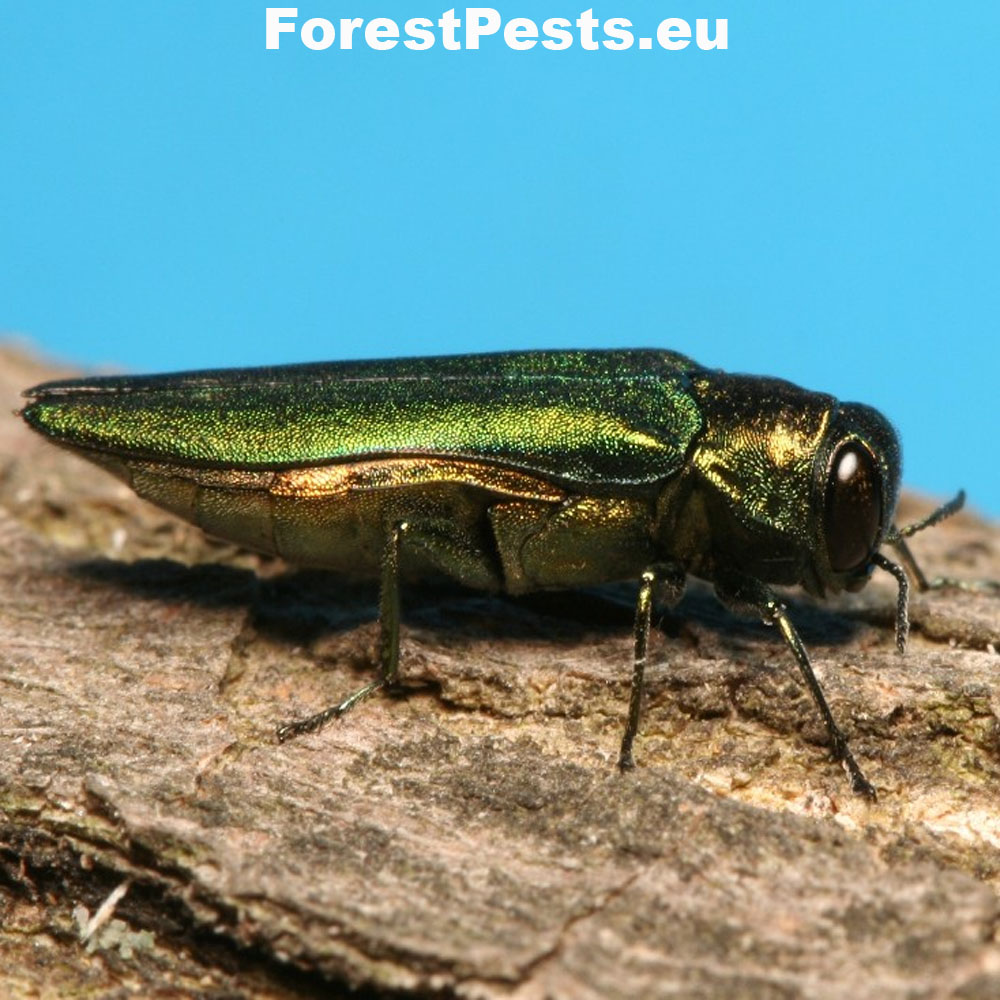
Imágo. Foto: Barry Lions, Natural
resources Canada, Canadian forest
service
|
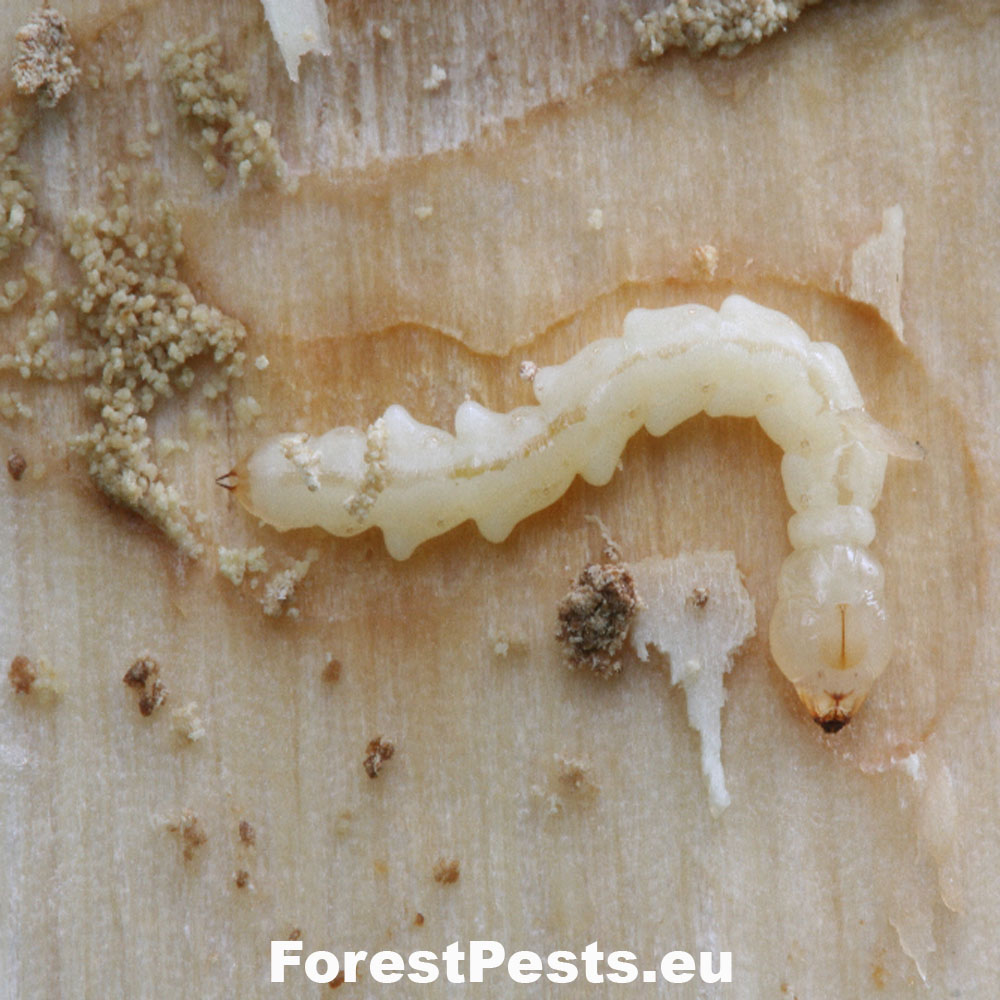
Larva. Foto: Barry Lions, Natural
resources Canada, Canadian forest
service
|
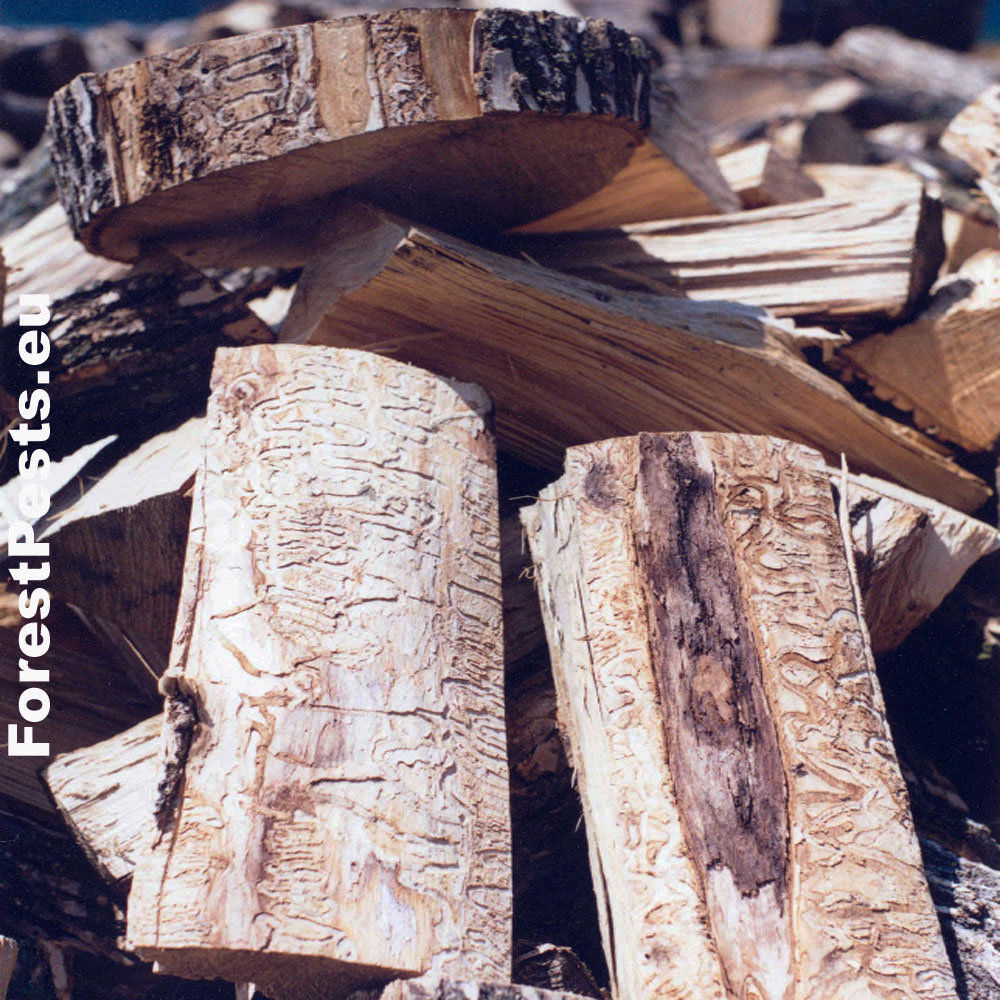
Napadnuté palivo. Foto: Troy Kimoto,
Canadian food Inspection Agency
|
Požerok. Foto: Troy Kimoto Canadian
food Inspection Agency
|
Ohrozené dreviny:
Hostiteľské dreviny sú najmä jasene (Fraxinus chinesis, F. japonica, F. lanuginosa, F. mandshurica, F. rhynchophylla), ale aj orech (Juglans mandshurica) a niektoré druhy brestov (Ulmus davidiana, U. propinqua).
Miesto poškodenia: Vetva, kmeň
Významnosť: Veľmi významný
Pôvod a rozšírenie:
Ohrozené porasty a územia:
Ohrozené sú najmä jasene v mestskej zeleni a parkoch a všetky porasty so zastúpením jaseňa, najmä v stredných a nižších polohách. Napáda aj orech (Juglans mandshurica) a niektoré druhy brestov (Ulmus davidiana, U. propinqua).Jeho význam rastie v súvislosti so silným napadnutím jaseňov hubou Hymenoscyphus pseudoalbidus.
Prevencia:
Kontrola výskytu:
Pochôdzkou sa kontrolujú symptómy napadnutia. Na monitoring tohto škodcu boli americkými vedcami vyvinuté lepové lapače (fialové, zelené) a odparníky, ktoré sa vešajú do korún jaseňov. Odparníky lákajú vôňou vädnúcich stromov (prirodzené atraktanty) škodcu, krasone sa po prílete na lapač prilepia.
 |
 |
|
Výletový otvor tvaru D. Foto: Jerry Dowding
Canadian food Inspection Agency
|
Napadnutý porast. Foto: Troy Kimoto,
Canadian food Inspection Agency
|
Obrana:
Obrana proti tomuto škodcovi je mimoriadne náročná. Jednoznačne sa musí pristúpiť k okamžitej asanácií napadnutých stromov, buď mechanicky (štiepkovanie, spálenie) alebo chemicky postrekom kmeňov a ťažbových zvyškov. Je zakázané prevážať jaseňové drevo z napadnutých oblastí do oblastí, kde ešte napadnutie potvrdené nebolo.
Kategória škodcu: Hmyz podkôrny
Zistený na Slovensku: Zatiaľ na Slovensku nebol zaznamenaný. Od roku 2016 prebieha intenzívny monitoring za účelom včasného zachytenia jeho prípadného výskytu.
Invázny druh: Áno
Podobné druhy: Všetky domáce druhy krasoňov rodu Agrilus.
Literatúra:
Anulewicz AC, McCullough DG, Cappaert DL, Poland TM, 2008: Host range of the emerald ash borer (Agrilus planipennis Fairmaire) (Coleoptera: Buprestidae) in North America: results of multiple-choice field experiments. Environmental Entomology, 37(1): s.230-241.
Baranchikov Y., Mozolevskaya E., Yurchenko G., Kenis M., 2008: Occurrence of the emerald ash borer, Agrilus planipennis in Russia and its potential impact on European forestry. Bulletin OEPP/EPPO Bulletin, 38(2): s.233-238. http://www.blackwell-synergy.com/loi/epp
Bauer LS., Liu H., Miller D., Gould JR., 2008: Developing a classical biological control program for Agrilus planipennis (Coleoptera: Buprestidae), an invasive ash pest in north America. Newsletter of the Michigan Entomological Society, 53: s.38-39.
Browne FG, 1968: Pests and diseases of forest plantation trees: an annotated list of the principal species occurring in the British Commonwealth. Oxford, UK: Clarendon Press.
Brown-Rytlewski DE, Wilson MA, 2005. Tracking the emergence of emerald ash borer adults. Emerald Ash Borer Research and Technology Development Meeting, Romulus, MI, 5-6 Oct. 2004. U.S. Department of Agriculture, Forest Service publication FHTET-2004-15 [ed. by Mastro, V. \Reardon, D.]. Washington, DC, USA: US Department of Agriculture, Forest Service, s.13-14.
CABI/EPPO, 2006. Agrilus planipennis. Distribution Maps of Plant Pests, No. 675. Wallingford, UK: CAB International.
Cappaert D, McCullough DG, 2009: Occurrence and seasonal abundance of Atanycolus cappaerti (Hymenoptera: Braconidae) a native parasitoid of emerald ash borer, Agrilus plonipennis (Coleoptera: Buprestidae). Great Lakes Entomologist, 42(1/2): s.16-29.
Cipollini D, 2015. White fringetree as a novel larval host for emerald ash borer.
Journal of Economic Entomology, January 2015. http://jee.oxfordjournals.org/content/early/2015/01/10/jee.tou026
EPPO, 2014: PQR database. Paris, France: European and Mediterranean Plant Protection Organization. http://www.eppo.int/DATABASES/pqr/pqr.htm
Forest Service USDA, 2009. Emerald Ash Borer. Michigan, USA: Michigan State University. http://www.emeraldashborer.info/
Groot Pde, Grant GG, Poland TM, Scharbach R, Buchan L, Nott RW, Macdonald L, Pitt D, 2008: Electrophysiological response and attraction of emerald ash borer to green leaf volatiles (GLVs) emitted by host foliage. Journal of Chemical Ecology, 34(9): s.1170-1179. http://www.springerlink.com/link.asp?id=104273
Haack RA, Jendek E, Houping Liu, Marchant KR, Petrice TR, Poland TM, Hui Ye, 2002: The emerald ash borer: a new exotic pest in North America. Newsletter of the Michigan Entomological Society, 47(3-4): s.1-5.
Hausman CE, Rocha OJ, Jaeger JF, 2008: How emerald ash borer facilitates a secondary spread of invasive plant species : Impacts of emerald ash borer eradication and tree mortality. Emerald ash borer research and development review meeting; 2007 October 23-24; Pittsburgh, Pennsylvania. FHTET 2007-04 [ed. by Mastro, V. \Lance, D. \Reardon, R. \Parra, G.]. Morgantown, West Virginia, USA: US Forest Service, Forest Health Technology Enterprise Team, s.14-15.
Herms DA, Ghandi KJK, Cardina J, Long RP, Knight KS, Smith A, McCullough DG, 2008: Emerald ash borer research and development review meeting; 2007 October 23-24; Pittsburgh, Pennsylvania. FHTET 2007-04 [ed. by Mastro, V. \Lance, D. \Reardon, R. \Parra, G.]. Morgantown, West Virginia, USA: US Forest Service, Forest Health Technology Enterprise Team, 10.
Lelito JP, Fraser I, Mastro VC, Tumlinson JH, Baker TC, 2008: Novel visual-cue-based sticky traps for monitoring of emerald ash borers, Agrilus planipennis (Col., Buprestidae). Journal of Applied Entomology, 132(8): s.668-674. http://www.blackwell-synergy.com/loi/jen
Liu HP, Bauer LS, Miller DL, Zhao TongHai, Gao RuiTong, Song LiWen, Luan QingShu, Jin RuoZhong, Gao ChangQi, 2007: Seasonal abundance of Agrilus planipennis (Coleoptera: Buprestidae) and its natural enemies Oobius agrili (Hymenoptera: Encyrtidae) and Tetrastichus planipennisi (Hymenoptera: Eulophidae) in China. Biological Control, 42(1):61-71. http://www.sciencedirect.com/science/journal/10499644
Lyons DB, Groot Pde, Jones GC, Scharbach R, 2009: Host selection by Agrilus planipennis (Coleoptera: Buprestidae): inferences from sticky-band trapping. Canadian Entomologist, 141(1): s.40-52.
McCullough DG, Poland TM, Cappaert D, Clark EL, Fraser I, Mastro V, Smith S, Pell C, 2007: Effects of chipping, grinding, and heat on survival of emerald ash borer, Agrilus planipennis (Coleoptera: Buprestidae), in chips. Journal of Economic Entomology, 100(4): s.1304-1315.
NAPPO, 2013. Phytosanitary Alert System: December 2013 Report: emerald ash borer found in new locations in Ontario and Quebec. Phytosanitary Alert System: December 2013 Report: emerald ash borer found in new locations in Ontario and Quebec. NAPPO. http://www.pestalert.org/oprDetail.cfm?oprID=572
OEPP/EPPO, 2005. Agrilus planipennis. Datasheets on quarantine pests. Bulletin OEPP/EPPO Bulletin, 35: s.436-438.
Orlova-Bienkowskaja MJ, Belokobylskij SA, 2014: Discovery of the first European parasitoid of the emerald ash borer Agrilus planipennis (Coleoptera: Buprestidae). European Journal of Entomology, 111(4): s.594-596.
Petrice TR, Haack RA, 2006: Efficacy of three insecticides applied to bark to control Agrilus planipennis (Coleoptera: Buprestidae). Great Lakes Entomologist, 39(1/2): s.27-33.
Poland TM, 2007: Twenty million ash trees later: current status of emerald ash borer in Michigan. Newsletter of the Michigan Entomological Society, 52: s.10-14.
Pureswaran DS, Poland TM, 2009: The role of olfactory cues in short-range mate finding by the emerald ash borer, Agrilus planipennis Fairmaire (Coleoptera: Buprestidae). Journal of Insect Behavior, 22(3): s.205-216.
Rajarapu SP, Mittapalli O, 2013: Glutathione-S-transferase profiles in the emerald ash borer, Agrilus planipennis. Comparative Biochemistry and Physiology. B, Biochemistry & Molecular Biology, 165(1): s.66-72.
Rebek EJ, Herms DA, Smitley DR, 2008: Interspecific variation in resistance to emerald ash borer (Coleoptera: Buprestidae) among North American and Asian ash (Fraxinus spp.). Environmental Entomology, 37(1): s.242-246.
Rodriguez-Saona C, Poland TM, Miller JR, Stelinski LL, Grant GG, Groot Pde, Buchan L, MacDonald L, 2006: Behavioral and electrophysiological responses of the emerald ash borer, Agrilus planipennis, to induced volatiles of Manchurian ash, Fraxinus mandshurica. Chemoecology, 16(2): s.75-86. http://www.birkhauser.ch
Schaefer PW, 2005: Foreign exploration for emerald ash borer and its natural enemies. Emerald Ash Borer Research and Technology Development Meeting, Romulus, MI, 5-6 Oct. 2004. U.S. Department of Agriculture, Forest Service publication FHTET-2004-15 [ed. by Mastro, V. \Reardon, D.]. Washington, DC, USA: US Department of Agriculture, Forest Service, 67.
Silk PJ, Ryall K, Lyons DB, Sweeney J, Wu JunPing, 2009: A contact sex pheromone component of the emerald ash borer Agrilus planipennis Fairmaire (Coleoptera: Buprestidae). Naturwissenschaften, 96(5): s.601-608.
Swink WG, Nalepa CA, Basham JP, 2014: Year-to-year variation in prey capture by Cerceris fumipennis (Hymenoptera: Crabronidae) at two sites in North Carolina. Annals of the Entomological Society of America, 107(6): s.1121-1125.
Timms LL, Smith SM, Groot Pde, 2006: Patterns in the within-tree distribution of the emerald ash borer Agrilus planipennis (Fairmaire) in young, green-ash plantations of south-western Ontario, Canada. Agricultural and Forest Entomology, 8(4):313-321. http://www.blackwell-synergy.com/servlet/useragent?func=showIssues&code=afe
Wagner DL, 2007. Emerald ash borer threatens ash-feeding Lepidoptera. News of the Lepidopterists' Society, 49(1): s.10-11. http://www.lepsoc.org
Wei Xia, Wu Yun, Reardon R, Sun TieHuan, Lu Min, Sun JiangHua, 2007: Biology and damage traits of emerald ash borer (Agrilus planipennis Fairmaire) in China. Insect Science, 14(5): s.367-373.
Yang ZhongQi, Strazanac JS, Marsh PM, Achterberg Cvan, Choi WonYoung, 2005: First recorded parasitoid from China of Agrilus planipennis: a new species of Spathius (Hymenoptera: Braconidae: Doryctinae). Annals of the Entomological Society of America, 98(5): s.636-642. http://www.esa.catchword.org
Yang ZhongQi, Strazanac JS, Yao YanXia, Wang XiaoYi, 2006: A new species of emerald ash borer parasitoid from China belonging to the genus Tetrastichus Haliday (Hymenoptera: Eulophidae). Proceedings of the Entomological Society of Washington, 108(3): s.550-558.
Yang ZhongQi, Wang XiaoYi, Yao YanXia, Gould JR, Cao LiangMing, 2012. A new species of Sclerodermus (Hymenoptera: Bethylidae) parasitizing Agrilus planipennis (Coleoptera: Buprestidae) from China, with a key to Chinese species in the genus. Annals of the Entomological Society of America, 105(5): s.619-627.
Yu C, 1992. Agrilus marcopoli Obenbarger. In: Xiao G, ed. Forest Insects of China. Beijing, China: China Publishing House, s.400-401.
Zhao TH, Zhao WX, Gao RT, Zhang QW, Li GH, Liu XX, 2007: Induced outbreaks of indigenous insect species by exotic tree species. Acta Entomologica Sinica, 50: s.826 - 833.
http://www.library.sk/arl-sldk/sk/detail-sldk_un_cat-0063953-Agrilus-planipennis-invazny-krason-na-jasenoch/
